
Published July 3, 2026
A Homeowner’s Guide to Capital Gains Tax Rules

Protecting Your Equity: A Homeowner’s Guide to Capital Gains Tax Rules
Over the past few years, homeowners have watched their home equity climb to historic heights. While watching your property value grow is incredibly exciting, it brings a crucial financial question to the surface when it's time to sell: How do I protect my profits from the tax collector?
As we move through the 2026 real estate market, capital gains tax rules remain one of the most searched real estate topics on the internet. Fortunately, the tax code contains a powerful provision specifically designed to shield primary homeowners from heavy tax bills.
Understanding how the Section 121 Exclusion works can help you map out your sale safely and keep your hard-earned equity right where it belongs—in your pocket.
1. The Core Shield: The IRS Exclusion Limits
The federal government does not tax your entire home sale profit, provided it was your primary home. Under current tax law, you can completely exclude a massive portion of your capital gains from your federal income taxes.
The tax-free profit limits depend entirely on your filing status:
- Single Filers: You can exclude up to $250,000 in profit.
- Married Couples (Filing Jointly): You can exclude up to $500,000 in profit.
What counts as "Profit"? Remember, capital gains are calculated based on your appreciation, not the total sales price. If you are a married couple who bought a home for $300,000 and sell it for $750,000, your net profit is $450,000. Because this falls below the $500,000 threshold, you owe $0 in federal capital gains tax.
2. The Golden Gatekeeper: The "2 Out of 5 Years" Rule
To pocket these tax-free profits, you must pass the IRS eligibility test, commonly known as the "2 out of 5" residency rule.
To qualify for the full exclusion, you must meet both of the following criteria within the five-year window ending on the exact date your home closes escrow:
- The Ownership Test: You must have legally owned the home for at least 24 months (2 years) out of those 5 years.
- The Use Test: You must have lived in the home as your primary residence for at least 24 months (2 years) out of those 5 years.
Important Nuances to Keep in Mind:
- The 24 months do not have to be consecutive. You could live in the house for one year, rent it out for two years, and move back in for another year. As long as the total time adds up to 2 full years within the 5-year lookback period, you pass.
- You generally cannot have used this primary residence exclusion on another home sale within the past two years.
3. The Paper Trail: Tracking Improvements to Offset Gains
What happens if you are fortunate enough to exceed the $250,000 or $500,000 profit thresholds? If your home has massively appreciated, you aren't automatically defenseless. You can artificially lower your taxable gains by recalculating your home's Adjusted Cost Basis.
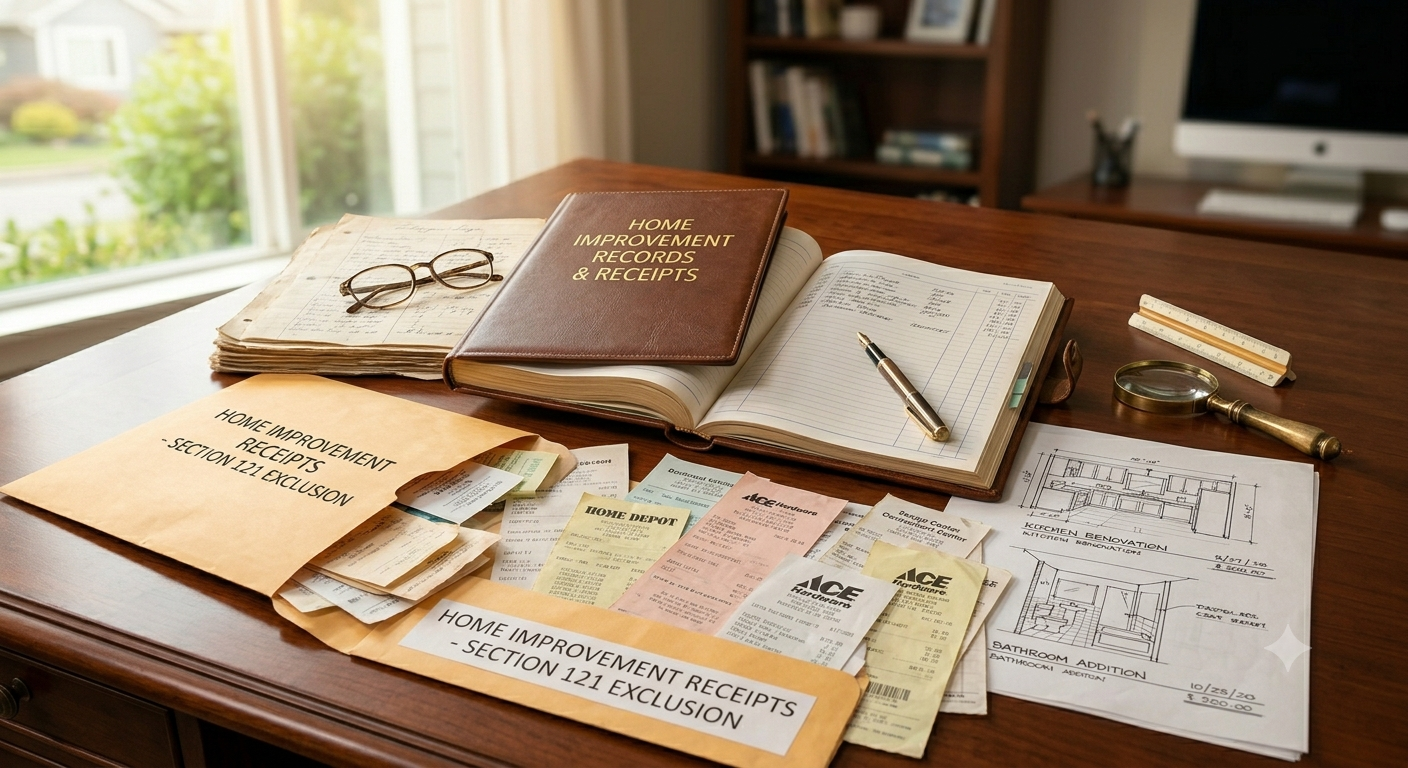
Your cost basis starts as the price you originally paid for the home. However, every time you make a capital improvement to the property, the IRS allows you to add that expense to your cost basis, which shrinks your taxable profit margin.
| What Alleviates Capital Gains (Capital Improvements) | What Does NOT Alleviate Capital Gains (Routine Maintenance) |
| Adding a bedroom or bathroom | Fixing a leaky faucet or broken pipe |
| Replacing the entire roof | Patching a few loose shingles |
| Installing a new central HVAC system | Annual servicing of your AC unit |
| Complete kitchen remodel or new flooring | Painting a room a different color |
| Paving a new driveway or installing a deck | Professional lawn mowing or yard cleanup |
The Strategic Takeaway: Save Every Receipt
If you bought your home for $400,000 and sell it for $950,000 as a married couple, your raw profit is $550,000—putting you $50,000 over the exclusion limit.
However, if you kept detailed receipts proving that you spent $60,000 over the years remodeling the kitchen and installing a new deck, your adjusted cost basis rises from $400,000 to $460,000. Your taxable profit instantly drops to $490,000, bringing you safely under the $500,000 limit and eliminating your tax liability.
The Bottom Line
With home values holding stable at elevated levels, tax planning needs to happen before your house hits the market, not during the following year's tax season. By knowing your filing limits, verifying your residency timeline, and organizing your home renovation receipts, you can step into the real estate market with complete financial confidence.
Disclaimer: Tax laws can vary depending on your overall bracket, state taxes, and individual financial history. Always consult with a certified public accountant (CPA) or tax professional before finalizing your real estate transaction.
Planning to list your home and want to ensure your listing strategy is aligned with your financial timelines? Contact us today for a comprehensive local market analysis!

Noah Kragerud
Team Lead | Ark Realty Group | Keller Williams Sunset Corridor
or another way