
Categories
Real EstatePublished April 7, 2026
The Hillsboro Market Has Split — What That Means for You in 2026

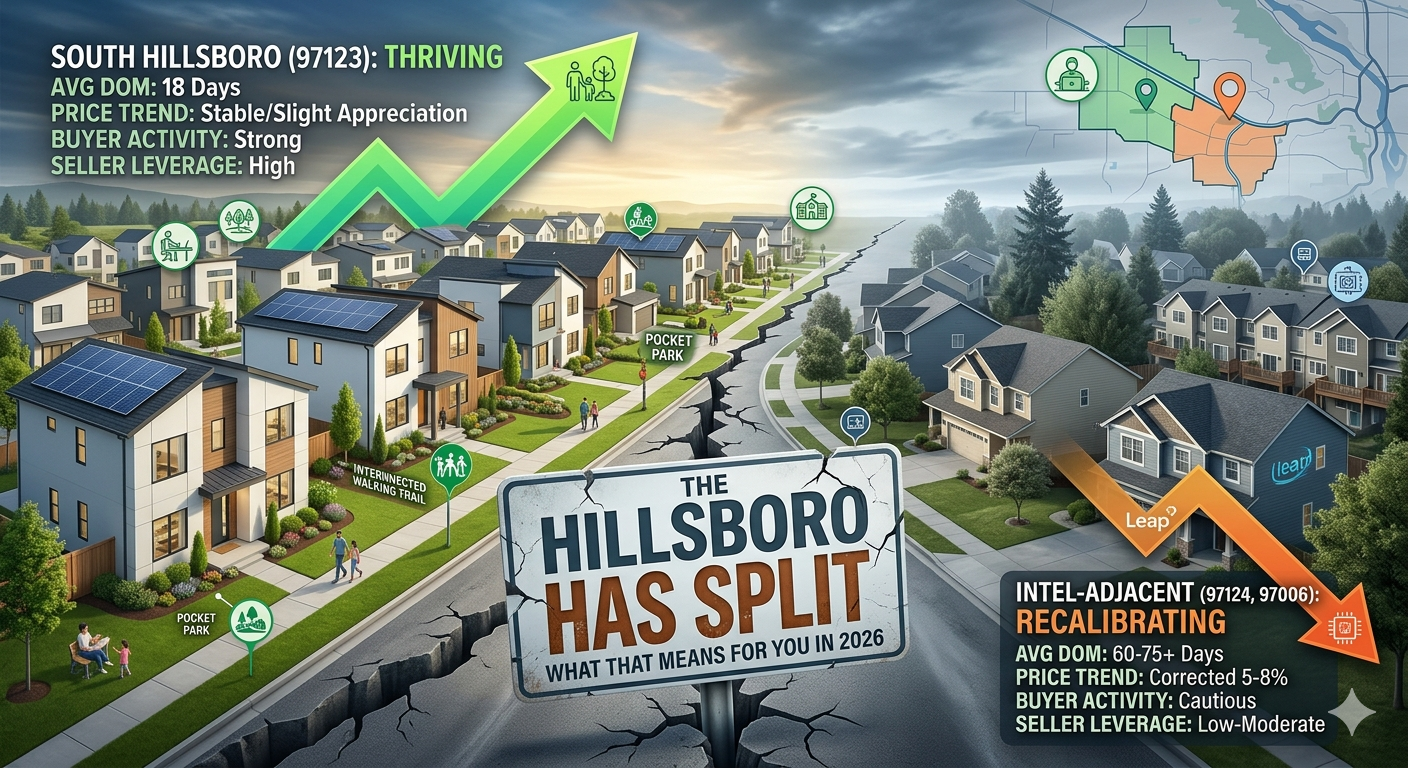
If you're trying to understand the Hillsboro real estate market right now, looking at city-wide averages will mislead you.
"Hillsboro median home price: $625,000."
"Days on market: 52 days."
"Inventory up 12% year-over-year."
Those numbers tell you nothing about what's actually happening on your street.
Because here's the reality that data obscures: the Hillsboro market hasn't just changed—it's split in half.
A home in South Hillsboro sells in 18 days with multiple showings and a clean offer. Three miles north in Orenco Station, a comparable home sits for 75 days, endures two price reductions, and closes $30,000 below the original list price.
Same city. Same market conditions. Completely opposite outcomes.
If you're a seller making decisions based on what you think "the Hillsboro market" is doing, you're likely operating with incomplete—or worse, incorrect—information.
This article breaks down exactly how and why the Hillsboro market bifurcated, what it means for sellers in each segment, and how to position yourself for success based on where your home actually sits.
The Division Is Real—and the Data Proves It
Let's establish what we're actually seeing in the numbers.
Hillsboro City-Wide (February 2026):
- Median sale price: ~$625K
- Average days on market: 52 days
- Inventory: Up 8% year-over-year
- Price trend: Down 2–3% from 2024 peaks
Now let's break that down by micro-market:
South Hillsboro (Reed's Crossing, Rosedale, South Hillsboro Resale - 97123):
- Average days on market: 18 days
- Price trend: Stable to slight appreciation
- Buyer activity: Strong and consistent
- Seller leverage: Moderate to high
Intel-Adjacent Neighborhoods (Orenco Station, AmberGlen, North Hillsboro - 97124, 97006):
- Average days on market: 60–75+ days
- Price trend: Corrected 5–8% from 2024 peaks
- Buyer activity: Cautious and selective
- Seller leverage: Low to moderate
The gap isn't subtle. And it's not temporary.
Two distinct markets are operating simultaneously within the same city limits, driven by fundamentally different buyer psychology, employment dynamics, and community infrastructure.
Why the Market Split: Three Structural Forces
Markets don't bifurcate randomly. There are specific, measurable reasons why South Hillsboro is thriving while Intel-adjacent neighborhoods are recalibrating.
Force #1: Single-Employer Dependency Created Vulnerability
The Intel Effect:
The 2024–2025 Intel layoffs weren't just an employment story. They were a psychological shock that rippled through every Intel-adjacent neighborhood.
Orenco Station, AmberGlen, and North Hillsboro were built—both literally and economically—around proximity to Intel campuses. When thousands of positions were eliminated, it didn't just affect the people who lost jobs. It affected everyone who worked at Intel, everyone who knew someone at Intel, and every buyer considering homes in those areas.
Even buyers with stable employment became risk-averse. They delayed purchases. They questioned long-term value. They shifted their search to neighborhoods with less concentrated employment dependency.
Result: Demand softened, inventory accumulated, and sellers had to adjust pricing to match the new buyer psychology.
The South Hillsboro Contrast:
Reed's Crossing and surrounding South Hillsboro communities never relied on a single employer.
Buyer demand comes from:
- Portland relocators seeking space and better value
- Dual-income families from diverse employment sectors
- Remote and hybrid workers less tied to specific campus locations
- Families prioritizing schools and lifestyle over employer proximity
When Intel struggled, South Hillsboro demand remained stable because it was never structurally dependent on one company's fortunes.
Force #2: New Construction Redefined the Competitive Landscape
The Certainty Premium:
Buyers in 2026 are paying a premium for certainty—and new construction delivers it in ways resale cannot match.
Reed's Crossing offers:
- Move-in ready homes with zero deferred maintenance
- Modern floor plans designed for remote work and 2026 living
- 10-year builder warranties eliminating near-term risk
- Energy-efficient systems (lower monthly utilities)
- Transparent pricing and builder incentives
When buyers compare a 15-year-old resale home in Orenco needing a new roof and HVAC updates to a brand-new home in Reed's Crossing with warranties, they're increasingly choosing predictability over price per square foot.
The Resale Challenge:
Intel-adjacent neighborhoods are competing against new construction on features where resale inherently struggles:
- Aging systems and components (roofs, HVAC, water heaters)
- Closed floor plans from 2005–2012 design trends
- No warranties or builder guarantees
- Higher perceived risk in an uncertain employment environment
Resale homes can win—but only when priced and positioned to compete on lot size, mature landscaping, established character, and value. Trying to compete dollar-for-dollar with new construction on features is a losing strategy.
Force #3: Lifestyle Infrastructure Became a Decisive Factor
Master-Planned Community Advantage:
Reed's Crossing isn't just houses on streets. It's built infrastructure:
- Miles of interconnected trails and greenways
- Pocket parks and gathering spaces every few blocks
- Town Center opening in 2025/2026 with retail, dining, services within walking distance
- Community events, farmers markets, social programming
- Design standards creating visual cohesion and long-term value stability
Buyers in 2026—especially families and Portland relocators—are prioritizing daily lifestyle experience over raw square footage. A 2,000 sq ft home with trail access and walkable amenities is beating a 2,400 sq ft home where you drive everywhere.
Traditional Neighborhood Reality:
Most North Hillsboro and Orenco neighborhoods were designed as bedroom communities:
- Car-dependent for shopping, dining, recreation
- Parks exist but require driving to access
- Limited walkable infrastructure
- Community feel relies on resident initiative, not built design
Neither model is inherently better—but buyer preferences have shifted, giving master-planned communities a structural advantage that doesn't disappear when interest rates fluctuate.
What the Market Split Means for Sellers in Each Segment
Your selling strategy in 2026 must reflect which side of the bifurcation you're on—not generic Hillsboro advice.
If You're Selling in South Hillsboro (Reed's Crossing, Rosedale, South 97123):
Your Market Reality:
- Homes are moving in under three weeks
- Buyer demand is consistent and strong
- Pricing supports market-rate expectations when condition and location align
- Competition from new construction validates your area but sets a high bar
What This Means for Your Strategy:
✅ Price at market value based on recent solds—demand supports appropriate pricing, but overpricing still kills momentum
✅ Prepare your home to compete with new construction—emphasize move-in ready condition, updated systems, and lifestyle features
✅ Stage to highlight modern living—open floor plans, functional spaces, clean aesthetics
✅ Move quickly—inventory is being absorbed fast; delays cost opportunity
✅ Highlight lifestyle advantages—trails, Town Center proximity, parks, community features
Your Biggest Risk:
Assuming strong demand means you can skip preparation or overprice. Even hot markets punish homes that aren't positioned correctly. Buyers will choose new construction with warranties over an overpriced resale home with deferred maintenance.
If You're Selling in Intel-Adjacent Neighborhoods (Orenco, AmberGlen, North Hillsboro):
Your Market Reality:
- Days on market averaging 60–75+ days
- Buyers are analytical, cautious, and comparison-shopping
- Price corrections from 2024 peaks are baked into buyer expectations
- Competition from South Hillsboro new construction offering certainty at comparable monthly payments
What This Means for Your Strategy:
✅ Price aggressively from day one—at or below recent sold comps to create urgency and competitive positioning
✅ Pre-inspect and address obvious issues—buyers in this segment are risk-averse; eliminate their objections upfront
✅ Highlight what resale offers that new construction cannot—larger lots, mature trees, established neighborhood character, lower HOA fees
✅ List early in Q1/Q2—avoid the spring inventory surge that will add even more competition
✅ Accept the new pricing reality—2023–2024 comps don't reflect current buyer psychology
Your Biggest Risk:
Pricing based on outdated comps and waiting for buyers to "come around" to your number. They won't. The buyers who wanted to pay 2024 prices already bought. Today's buyers are comparing you to new construction and pricing accordingly.
Sitting on the market 75+ days doesn't prove buyers are being unreasonable—it proves your pricing doesn't match current demand.
The Pricing Reality Sellers Must Accept
Regardless of which segment you're in, one truth applies universally:
The first two weeks on market determine your entire outcome.
In South Hillsboro:
Correctly priced homes generate multiple showings immediately, receive offers within 14–21 days, and close at or near asking price with minimal negotiation.
Overpriced homes sit for 30+ days, lose momentum, and eventually sell after price reductions—costing you carrying costs, buyer enthusiasm, and negotiating leverage.
In Intel-Adjacent Neighborhoods:
Correctly priced homes stand out as the "smart buy" in their area, generate consistent showings, and close within 45–60 days with realistic negotiations.
Overpriced homes sit for 75+ days, develop market stigma, and eventually close $20K–$40K below the original list price after multiple reductions—costing far more than if you'd priced correctly from day one.
The Math That Matters:
Scenario A: Overpriced from Day One
- List price: $625K (based on 2024 comp)
- Days on market: 75 days
- Price reductions: Two ($610K, then $595K)
- Final sale price: $585K
- Carrying costs (mortgage, utilities, maintenance): $7,500
- Net effective price: $577,500
Scenario B: Priced Correctly from Day One
- List price: $595K (based on current sold data)
- Days on market: 18 days
- Price reductions: None
- Final sale price: $598K
- Carrying costs: Minimal
- Net effective price: $597K
Real cost of overpricing: $19,500 minimum—and that doesn't account for stress, showing fatigue, or lost opportunity on your next purchase.
How to Position Yourself for Success
Whether you're in South Hillsboro or an Intel-adjacent neighborhood, success in spring 2026 requires micro-market awareness and strategic positioning.
Step 1: Identify Which Market Segment You're Actually In
Don't guess. Look at:
- Recent sold data in your immediate neighborhood (last 60 days)
- Average days on market for comparable homes
- Price trends (appreciating, stable, or correcting)
- Buyer activity patterns (multiple showings quickly vs. slow trickle)
Your strategy must reflect your actual market position—not where you wish you were or what county-wide data suggests.
Step 2: Price Based on Current Reality, Not Historical Comps
The most expensive mistake sellers make is pricing based on what a neighbor sold for in 2023 or early 2024.
That market doesn't exist anymore.
What matters:
- What have comparable homes actually sold for in the last 30–60 days?
- How long did they sit on market?
- What condition were they in relative to yours?
- What's the current buyer psychology in your specific area?
Pricing is not an art—it's a data exercise. Emotion and nostalgia cost you money.
Step 3: Prepare Your Home to Compete in Your Segment
In South Hillsboro:
- Emphasize move-in ready condition
- Update dated finishes that make buyers compare you unfavorably to new construction
- Stage to highlight modern living and functionality
- Ensure systems are recently serviced or replaced
In Intel-Adjacent Neighborhoods:
- Pre-inspect and address deferred maintenance (buyers will find it anyway)
- Highlight larger lots, mature landscaping, established character
- Price to compete on value, not features
- Make your home the "smart resale buy" vs. overpriced competition
Step 4: Market Aggressively in the Critical First Two Weeks
Peak buyer attention happens when your home is fresh to market.
✅ Professional photography (non-negotiable)
✅ Staging that highlights space and lifestyle
✅ Immediate response to showing requests
✅ Open houses and agent previews
✅ Targeted digital marketing to active buyers in your area
Momentum in the first 14 days determines whether you sell quickly at market value or sit for months with price reductions.
Step 5: Be Willing to Adjust Quickly If Market Feedback Demands It
If you're not getting showings within the first two weeks, or consistent buyer feedback points to pricing concerns, adjust immediately.
Small $5K reductions every three weeks signal desperation and don't reset buyer perception.
One meaningful adjustment ($15K–$25K) demonstrates you're serious about selling and repositions your home as fresh inventory.
The Bottom Line: One City, Two Markets
The Hillsboro real estate market in 2026 isn't a single story.
It's South Hillsboro's continued strength driven by lifestyle infrastructure, diversified buyer demand, and new construction momentum.
It's Intel-adjacent neighborhoods recalibrating after employment volatility, competing with new construction certainty, and adjusting to new buyer psychology.
Both markets have sellers succeeding right now.
The difference is that successful sellers understand which market they're in—and price, prepare, and position accordingly.
The sellers struggling are the ones applying generic advice, pricing based on outdated comps, and waiting for a market that isn't coming back.
Key Takeaways
✅ The Hillsboro market has bifurcated into two distinct segments—not one unified market
✅ South Hillsboro is moving fast (~18 days) due to lifestyle infrastructure and diversified demand
✅ Intel-adjacent neighborhoods are slower (60–75+ days) due to employment psychology and new construction competition
✅ Your pricing strategy must reflect your specific micro-market—city-wide averages don't apply
✅ The first two weeks on market determine your outcome—correct pricing and preparation matter more than ever
Get Your Personalized Market Position Review
The worst decision you can make as a Hillsboro seller in 2026 is treating your home as if it exists in a generic "Hillsboro market."
It doesn't. You're in one of two very different market segments—and your strategy must reflect which one.
📲 Ready to understand your specific market position? DM me or drop a comment and let's schedule a Market Position Review. I'll show you:
- Recent sold data in your immediate micro-market (not city-wide averages)
- How your home compares to active competition
- Strategic pricing recommendations based on current buyer behavior
- What preparation will maximize your sale price and minimize days on market
- Timeline recommendations for optimal positioning
📊 Thinking about listing this spring? Let's build a strategy based on where your home actually sits in the Hillsboro market—not assumptions or outdated data.
The market has split. Make sure your pricing and positioning strategy reflects your actual competitive reality.

Noah Kragerud
Team Lead | Ark Realty Group | Keller Williams Sunset Corridor
or another way