Published March 6, 2026
Why Pricing Right Matters More Than Ever in 2026

Why Pricing Right Matters More Than Ever in 2026
There are two types of sellers in North Hillsboro right now.
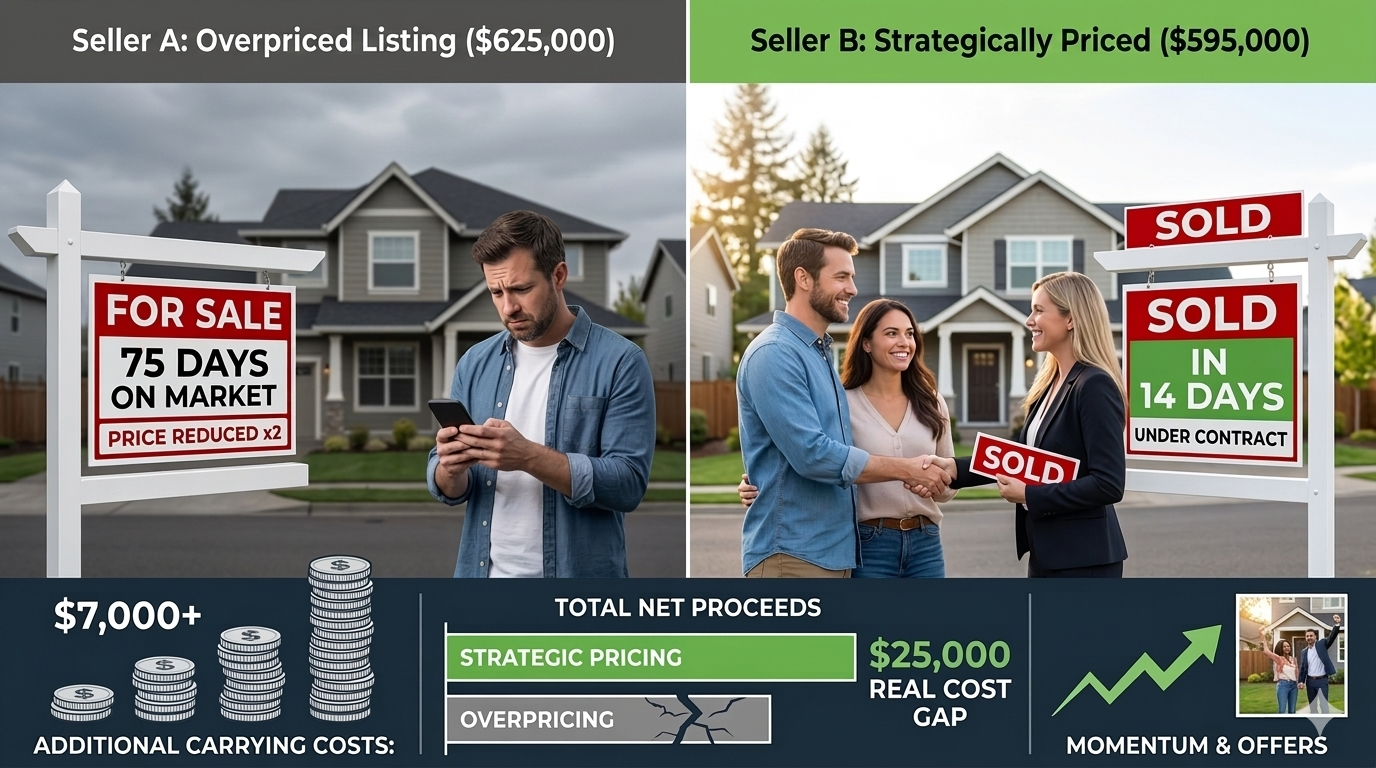
The first group lists their home at $625,000 based on what their neighbor sold for in 2023. They sit on the market for 75 days, drop the price twice, and eventually close at $585,000—after paying an extra two months of mortgage, utilities, and opportunity cost.
The second group lists at $595,000 from day one. They get multiple showings in the first week, an offer within 14 days, and close at $598,000 with a smooth transaction and minimal carrying costs.
Same neighborhood. Same home type. Difference of $7,000 at closing—but the real cost gap is closer to $25,000 when you factor in holding costs, price reductions, and buyer psychology.
In 2026, pricing strategy isn't just important. It's the single biggest determinant of whether you win or lose as a seller.
If you're in North Hillsboro, Brookwood, or any Intel-adjacent neighborhood still recalibrating from 2025's market shifts, this article breaks down exactly why pricing right from day one matters more than ever—and what "right" actually means in today's market.
The Market Reality: North Hillsboro Is in Price Discovery Mode
Let's ground this in data.
North Hillsboro and Brookwood neighborhoods have experienced measurable shifts over the past 18 months. Following the mid-2025 Intel layoffs and subsequent buyer psychology changes, these Intel-adjacent areas have seen:
- Days on market extending to 60–75+ days (vs. county average of 52 days)
- Price corrections of 5–8% from 2024 peak values
- Buyer scrutiny at all-time highs (more inspections, more negotiations, more hesitation)
- Competition from South Hillsboro new construction offering certainty at comparable price points
This isn't a market crash. It's price discovery.
Values aren't collapsing—they're adjusting to reflect current buyer demand, employment uncertainty in the tech corridor, and competition from communities like Reed's Crossing that offer turnkey convenience.
But here's the critical insight: homes priced correctly from day one are still selling. The ones sitting for months are the ones clinging to outdated comps and 2023 pricing psychology.
Why Overpricing Costs You More Than the Price Reduction
Most sellers understand that overpricing might mean reducing the price later.
What they don't calculate is the total cost of overpricing—which extends far beyond the listing price.
The Real Cost Breakdown:
Carrying Costs:
- Mortgage payments during extended days on market
- Utilities, insurance, HOA fees
- Lawn care, snow removal, ongoing maintenance
- Two months of carrying costs on a $600K home = $6,000–$8,000 in pure loss
Opportunity Cost:
- Equity sitting unused instead of being deployed into your next home
- Missing out on builder incentives or purchase opportunities that expire
- Delayed life transitions (job relocation, upsizing, downsizing)
Buyer Psychology Penalty:
- Homes that sit develop a "stigma" after 30 days
- Buyers assume something is wrong and low-ball even after price reductions
- You're now negotiating from weakness instead of strength
- Price reductions signal desperation, attracting bottom-feeder offers
Marketing Momentum Loss:
- Peak buyer attention occurs in the first 7–14 days
- Every agent in town shows your home first when it's new to market
- After 30 days, it becomes "that house that won't sell"
- Price reductions don't restore initial momentum—you've already burned it
The Math:
Overpriced home at $625K:
- Sits 75 days
- Two price reductions ($610K, then $595K)
- Final sale: $585K
- Carrying costs: $7K
- Total effective price: $578K
Correctly priced home at $595K:
- Sells in 14 days
- Final sale: $598K
- Minimal carrying costs
- Total effective price: $597K
Real cost of overpricing: $19,000 minimum
And that doesn't account for stress, showing fatigue, or the psychological toll of watching your home sit while neighbors sell.
What "Pricing Right" Actually Means in 2026
"Pricing right" doesn't mean guessing.
It means building a pricing strategy based on objective market behavior—not emotion, not what you paid, not what you need to break even, and definitely not what Zillow says.
The Framework:
1. Analyze Actual Sold Data (Not Active Listings)
What homes are listed for is irrelevant. What matters is what homes actually sold for in the last 30–60 days.
Focus on:
- Comparable square footage (within 10%)
- Same neighborhood or immediate adjacent area
- Similar age and condition
- Sold within last 60 days (not pending, not active)
Active listings at inflated prices don't set the market—they just sit there proving buyers won't pay those numbers.
2. Adjust for Condition and Upgrades
Two identical floor plans can have vastly different market values based on:
- Updated kitchens and bathrooms (adds 3–5% value)
- New roof, HVAC, windows (adds perceived value and reduces buyer risk)
- Finished basements or added square footage
- Deferred maintenance (reduces value significantly)
If your home needs a new roof or the HVAC is 18 years old, buyers will discount your price or demand credits. Factor this in upfront.
3. Account for Micro-Market Momentum
Not all North Hillsboro neighborhoods are performing equally.
Areas with:
- Better school boundaries (higher demand)
- Mature landscaping and established feel (appeals to certain buyers)
- Proximity to parks and trails (lifestyle value)
- Less Intel employment concentration (diversified buyer pool)
...will command slight premiums over areas heavily dependent on a single employer.
4. Factor in Days on Market Trends
If comparable homes in your area are sitting 65+ days, that's not a negotiation point—it's a market signal.
Pricing aggressively (at or slightly below recent solds) creates urgency and positions you as the "smart buy" in your neighborhood.
5. Understand Buyer Alternatives
Your competition isn't just other resale homes in North Hillsboro.
It's:
- New construction in Gordon Creek Pointe (starting low $400Ks)
- Reed's Crossing homes with warranties and modern layouts
- Tanasbourne homes with better retail proximity
- Orenco Station homes in similar price ranges
Buyers are comparing your home to all available options. If your pricing doesn't reflect competitive positioning, they'll choose certainty elsewhere.
The Psychological Mistake: Pricing "Room to Negotiate"
One of the most common seller strategies is pricing $20K–$30K above market value to "leave room for negotiation."
This backfires in 2026 for three reasons:
1. Today's Buyers Are Educated
They have access to the same sold data you do. They know what homes actually sell for. When they see your home priced 8% above recent comps, they don't think "room to negotiate"—they think "overpriced" and move on.
2. You Miss the Critical First Two Weeks
Homes priced correctly generate showings immediately. Overpriced homes sit empty during the most important marketing window—when every agent is previewing new listings and buyer attention is highest.
By the time you reduce to market value, you've lost momentum.
3. Price Reductions Don't Reset the Clock
When you drop your price after 45 days, buyers don't see it as a "fresh opportunity." They see a home that wouldn't sell at the original price and assume either:
- Something is wrong with the property
- The seller is desperate
- There's room to low-ball even further
You've now positioned yourself as a weak negotiator instead of a confident seller.
The Strategic Pricing Approach for North Hillsboro Sellers
If you're preparing to list in North Hillsboro or Brookwood, here's the playbook:
Step 1: Get a Comprehensive Market Analysis
Not a Zillow estimate. Not what your neighbor thinks their home is worth.
A real comparative market analysis including:
- 90 days of sold data in your immediate area
- Active listings (your competition)
- Pending sales (market direction indicators)
- Days on market trends
- Price per square foot benchmarks
Step 2: Pre-Inspect and Address Red Flags
Buyers in 2026 are risk-averse. Homes with obvious deferred maintenance get discounted aggressively.
Consider:
- Pre-listing inspection to identify issues before buyers do
- Addressing major systems (roof, HVAC, water heater) if they're near end of life
- Cosmetic updates that signal "well-maintained" (fresh paint, clean carpets, landscaping)
You don't need to renovate—but you need to eliminate obvious objections.
Step 3: Price at or Slightly Below Market
This isn't "leaving money on the table." It's strategic positioning.
Benefits of aggressive pricing:
- Maximum showing activity in first 14 days
- Creates urgency and potential for multiple offers
- Positions your home as the "smart buy" vs. overpriced competition
- Reduces days on market and carrying costs
- Strengthens your negotiating position
A home that sells in 14 days at $595K nets you more than a home that sits 75 days and sells at $585K after two price drops.
Step 4: Time Your Listing Strategically
Q1 2026 (January–March) offers a distinct advantage:
- Lower inventory than spring surge (less competition)
- Serious buyers with fresh pre-approvals (not tire-kickers)
- Stronger builder incentives motivating buyers to act before Q2
- Less showing fatigue (buyers aren't burned out from months of searching)
Listing in February–early March positions you ahead of the spring inventory wave hitting in April–May.
Step 5: Market Aggressively in the First Two Weeks
Your pricing strategy only works if buyers see your home.
First two weeks checklist:
- Professional photography (non-negotiable)
- Staged to highlight space and function
- Open houses and agent previews
- Targeted digital marketing to buyers searching your area
- Immediate response to showing requests (no 48-hour delays)
Momentum in the first 14 days determines your entire transaction outcome.
When to Hold Firm vs. When to Adjust
Not every price reduction means you priced wrong initially. Markets shift.
Signs you should hold your price:
- Strong showing activity (8+ showings in first two weeks)
- Buyer feedback is positive with no consistent objections
- Recent comps support your pricing
- It's been less than 21 days on market
Signs you need to adjust:
- Minimal showing activity (fewer than 5 showings in three weeks)
- Consistent buyer feedback about price relative to condition
- New comps sold below your pricing
- Days on market exceeding 30 with no offers
The key: Make pricing adjustments quickly and decisively. Small $5K reductions every three weeks signal desperation. One meaningful adjustment ($15K–$25K) resets market perception.
What North Hillsboro Sellers Need to Understand
The North Hillsboro market in 2026 isn't broken—it's different.
Homes are selling. But they're selling based on strategic pricing, not wishful thinking.
The sellers winning right now are:
- Pricing based on recent sold data, not 2023 peaks
- Pre-inspecting and addressing obvious issues
- Marketing aggressively in the first two weeks
- Understanding their competition includes new construction alternatives
- Accepting that price discovery is part of market normalization
The sellers struggling are:
- Clinging to outdated comps
- Pricing with "room to negotiate"
- Letting homes sit 60+ days before making adjustments
- Ignoring deferred maintenance and condition issues
- Waiting for "the market to come back" to their number
Your home will sell. The only question is: at what cost?
Pricing right from day one minimizes carrying costs, maximizes negotiating leverage, and gets you to your next chapter faster.
Overpricing costs you time, money, and momentum you can never recover.
Key Takeaways
✅ Overpricing costs $15K–$25K+ in carrying costs, lost momentum, and buyer psychology penalties
✅ North Hillsboro is in price discovery mode—values are adjusting, not collapsing
✅ The first 14 days determine your outcome—correct pricing maximizes this window
✅ "Room to negotiate" pricing backfires—educated buyers skip overpriced homes
✅ Strategic pricing = faster sale + higher net proceeds than overpricing and reducing later
Let's Build Your Pricing Strategy
If you're thinking about selling in North Hillsboro, Brookwood, or any Intel-adjacent neighborhood in 2026, the worst thing you can do is guess at pricing.
📲 Thinking about listing this spring? Drop a comment or send me a DM. Let's run a comprehensive market analysis based on actual sold data—not Zillow estimates or outdated comps.
📊 Want to understand what your home would net at different price points? Let's model it out.
Pricing right isn't about leaving money on the table. It's about understanding market behavior and positioning your home to win.
The market has shifted. Make sure your pricing strategy has too.